


We imagine a future where:
Your cancer therapy continuously adapts based on live data recorded from your body
Your doctor monitors and treats you 24/7 from the comfort of your home
You only take drugs that you know are working
Technology is advancing at an extraordinary pace, opening new possibilities for realizing this vision. Our core insight is that the feedback loop between starting cancer treatment and receiving information on if it’s working is too slow. While scans and blood tests provide essential snapshots of a tumor’s state, physical symptoms are our only way of knowing how well treatment is working in between measurements.
At Coherence, we believe there is a better way. It starts with building the tools to ‘watch’ cancer in real-time, and using that data to feed closed-loop algorithms—a kind of cancer therapy that could continuously ‘learn’ to improve itself.
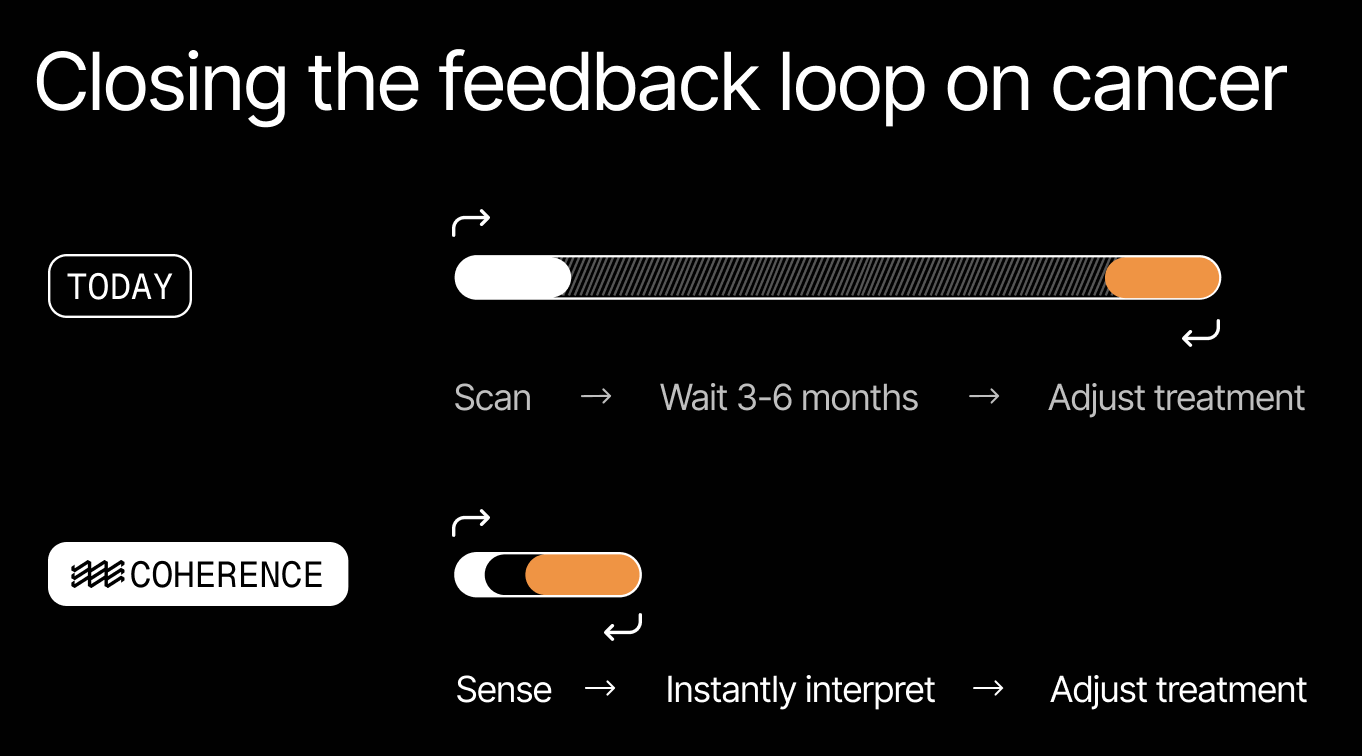
As an interdisciplinary team of engineers, neuroscientists, biologists, and doctors, we have worked tirelessly to define the world’s first electrical biomarker of cancer. You could think of this like threat detection in cyber security—as cancer grows in your body, it alters the electrical signals rippling through the tissue surrounding a tumor and the nervous system as a whole. By collecting time-series recordings of cancer as it grows and comparing it to systems functioning correctly, we can start to pick up ‘anomalies.’ With enough continuous data, we suddenly have a way to know whether cancer is growing, shrinking, or even recurring during remission without having to wait for the next scan or blood test.
Predicting cancer’s growth from neural activity in real-time
We’ve begun validating our electrical biomarkers in preclinical mouse models. Described in the paper linked above, we first developed and implanted tiny recording devices alongside a growing brain tumor. Using these recordings, we trained a model to predict a tumor’s growth trajectory from its neural activity. The plot below demonstrates how the model performs on unseen mice over time; comparing untreated vs treated with standard of care chemotherapy, Temozolomide (TMZ).
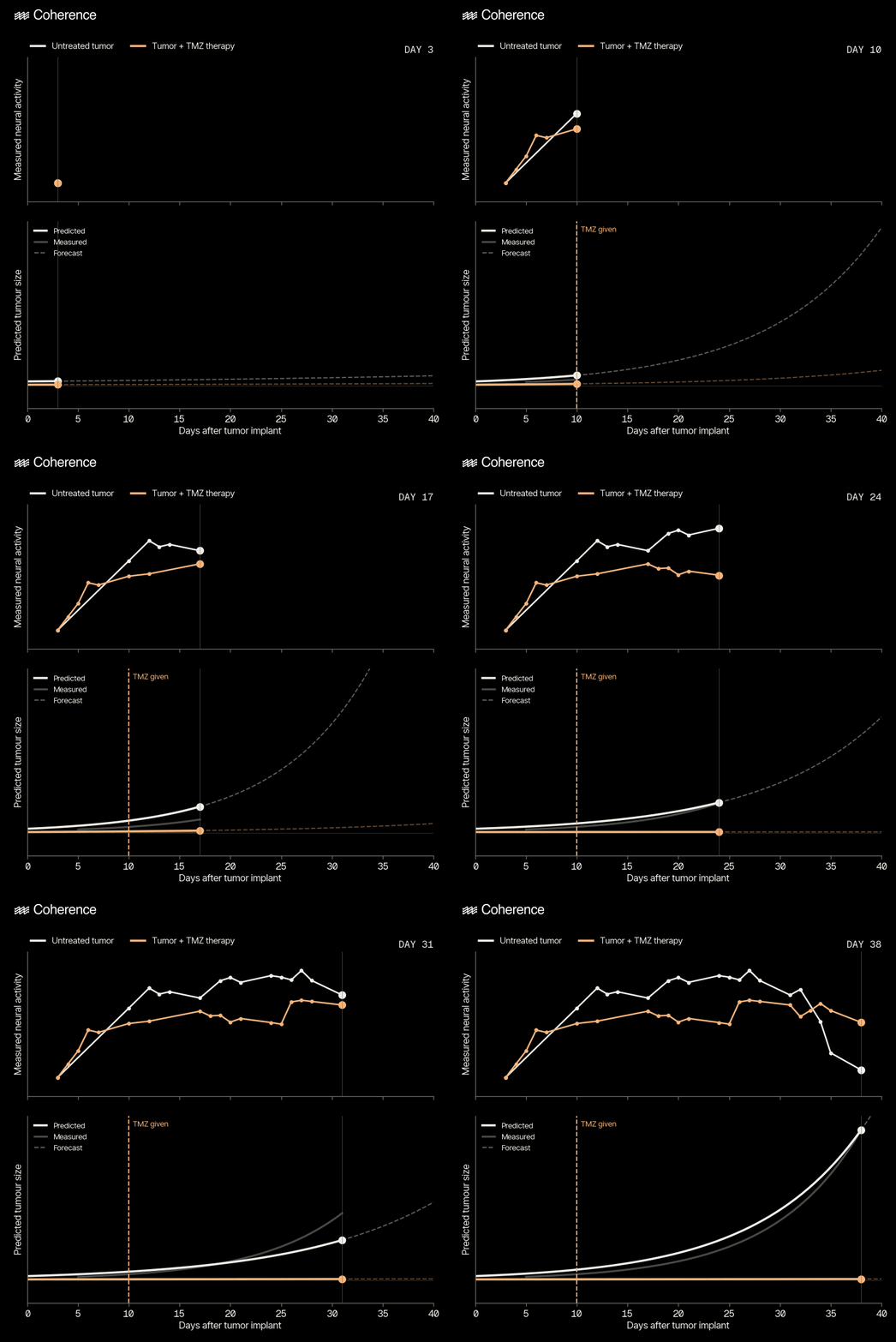
And from here we see the first input into a learning algorithm. Our models get better at predicting tumor growth trajectories with more days of data. The more accurate this ‘feedback’ on tumor progression becomes, the more effectively we can use it to adjust therapy and maximise patient survival and quality of life.
If these findings translate to humans, everything about how cancer is managed both through treatment and remission is set to evolve. In the future, instead of arbitrary scans or waiting for symptoms during the 5 year cancer remission period, patients could be continuously monitored for the earliest sign of recurrence. Cancer kills when it spreads, so the earlier we pick it up, the better we get at avoiding that spread. It’s also a dramatically more efficient way to administer healthcare, only using expensive in-hospital imaging & medical resources when needed for confirmation instead of intermittent screening which mostly comes up negative.
Building towards a closed-loop treatment device
Electricity flows throughout our bodies, and these electrical cues prompt downstream biological processes and vice versa in a feedback loop. So not only could we measure cancer from its aberrant electrical activity, but we could also treat it with electrical stimulation in a single device.
This is not science fiction. Electric field therapy is already FDA approved for some of the most deadly cancers, including glioblastoma and pancreatic cancer. The problem is these are static approaches and don’t record data. They can’t ‘learn.’
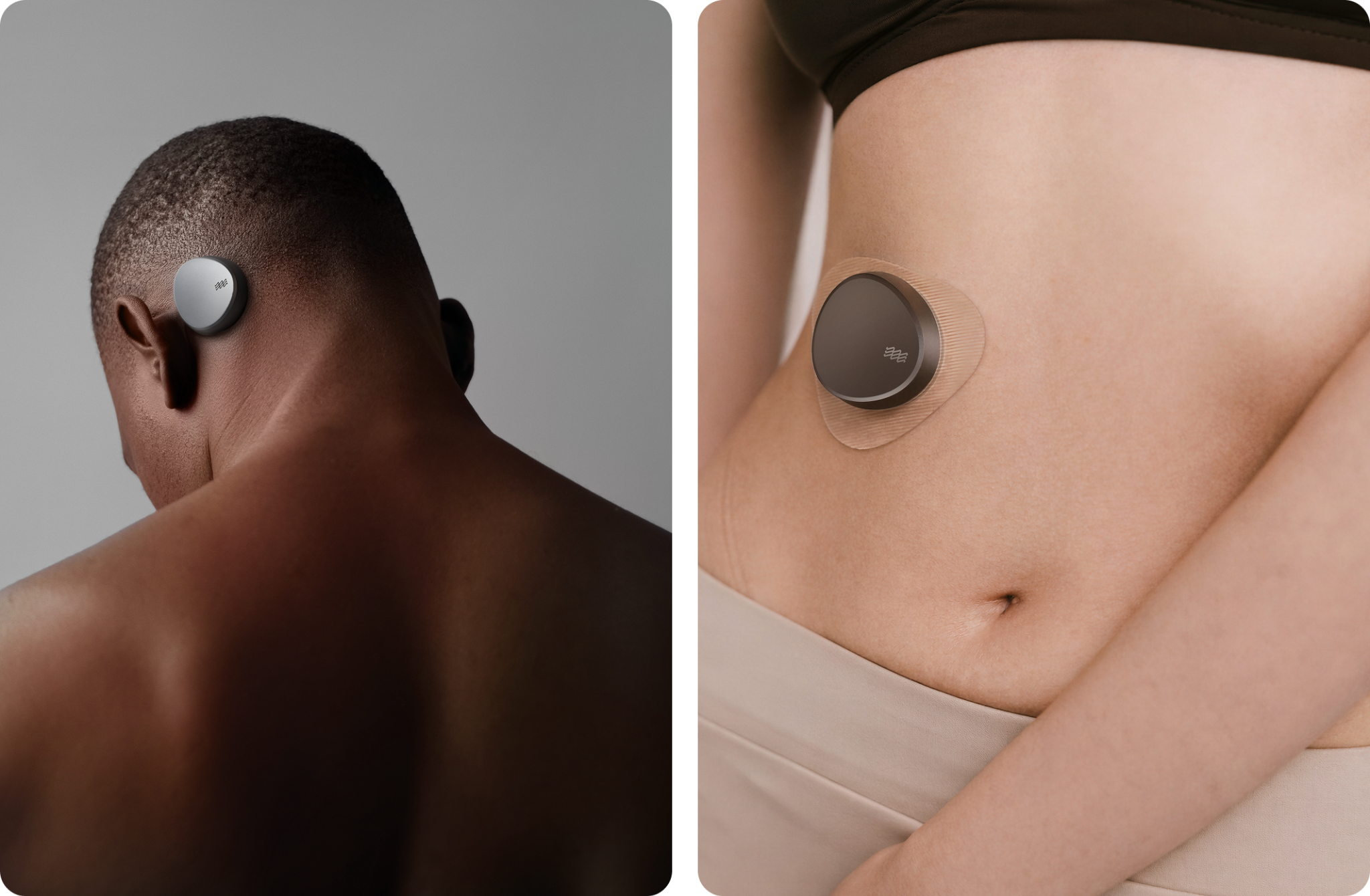
By combining the most advanced techniques in materials science, neurotechnology, and clinical engineering, we are developing a platform of read/write devices to track and treat cancer in real time. Coherence is laying the groundwork for a cancer hardware ecosystem that gets better with more data. We have already begun testing our devices in human trials, and will be accelerating development from now.
Backed by Founders Fund and The OpenAI Startup Fund
Founders Fund and The OpenAI Startup Fund have backed Coherence with $45m to redefine how cancer is treated. We are also joined by new investors Lux Capital, 8VC, Timeless, Olive Capital, and Ahren, alongside angels including Neuralink’s Head Neurosurgeon, Dr. Matthew MacDougall, and Neuralink Principal Investigator, Dr. Rory Murphy. Romina Nejad, Chad Byers, and Maor Shlomo are also onboard. And finally, thank you to our earliest believers who have doubled down: Blackbird, Possible, Topology, Artesian, XEIA, Xtal, & Divergent.
While we recognize that the extraordinary complexity of biology is likely to bring unforeseeable challenges, we are excited about what never-before-seen continuous human data will teach us about cancer. Ultimately, cancer is a process that evolves over time, yet we’ve never had the tools to watch this happening live. What will we learn? Where could this lead?
With this funding round, we’re pushing ahead to our first chronic human trial in glioblastoma, seeking FDA breakthrough device designation, and expanding our pre-clinical pipeline across pancreatic cancer and beyond. To achieve all this, we’re growing our team of cross-disciplinary builders and operators.
Want to join the Coherence mission?
If you’re a dreamer with unbounded curiosity and awe at what remains to be discovered about biological life, you might find a home here. You’ll work on hard technical problems with cutting edge tools in a wide-open space, backed by the best frontier tech investors in the world. Open roles across our San Francisco and Cambridge (UK) offices are up on our careers page. And if you don’t see yourself there but think you’re the perfect fit, then reach out to a member of our team!
We’re inventing cancer therapy that learns. We can’t wait to meet you.
Ben Woodington and Elise Jenkins.
Whatchugot?